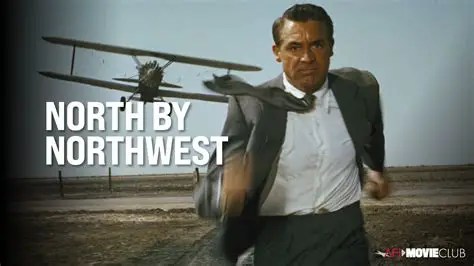
My first exposure to NORTH BY NORTHWEST came in a rather unusual way. It was on a Friday night in the fall of, let’s say, 1966. I had just returned home from an Austin High School football game. I turned on the TV and watched the last few minutes of NORTH BY NORTHWEST which was airing on the CBS FRIDAY NIGHT MOVIE. I came in right at the moment when Roger Thornhill (Cary Grant) and Eve Kendal (Eva Marie Saint), on the run from the bad guys, come upon the backs and tops of the giant stone presidential heads on Mount Rushmore. It was an image that stayed with me for years. I watched the climax of the film, with various characters clambering down the enormous heads and then, suddenly the film was over. I wondered what I had missed, what the rest of the movie was all about but it would be years before I finally found out.
During the spring semester of my freshman year at UT, I took a film history class. We watched a movie each week with screenings held at the Jester Auditorium. One of the films we saw was Alfred Hitchcock’s magnificent thriller, NORTH BY NORTHWEST. Finally, a chance to see this legendary film in its entirety.
What I discovered was Hitchcock’s most entertaining film, a chase thriller propelled by one of the master of suspense’s favorite thematic concerns, that of mistaken identity and a regular fellow suddenly plunged into the deadly world of Cold War espionage. In many ways, NXNW prefigures the James Bond films which would take the world by storm in the 1960s (which were right around the corner from 1959). Star Cary Grant makes a perfect American Bond, a capable and competent hero for a new age. And for film fans of a certain generation, it’s easy to project Leo G. Carroll’s role as “The Professor” as being one Alexander Waverly himself, a senior intelligence officer who would one day command U.N.C.L.E in the swinging sixties.
Bottom line is that I flat out loved the film. I’ve seen it multiple times since then. I have the Blu-Ray on my shelf along with my other Hitchcock films. But when we had the chance to see it on the big screen again, Judy and I quickly purchased our tickets.
No film summary will be found here and thus, no spoiler alerts. Instead, I just want to remark on several things that help elevate this film to classic status. To begin with, literally as the MGM lion is roaring, we hear the first bass notes of Bernard Herrman’s masterful score. NXNW owes much of its success to Herrman’s propulsive score, part heavy percussion and low-end woodwinds such as the bassoon and oboe to add sonic menace.
And there’s the brilliantly designed (by Saul Bass) animated titles whose intersecting lines hint at a map of action that the characters will follow throughout the film.
The justly famous crop duster sequence is one of the all-time great set pieces in the cinema of Alfred Hitchcock. With minimal dialog, the sequence is pure cinema as Hitchcock uses only the images to tell the story, abandoning Herrman’s score for the duration of the chase. The music crashes in on a thunderous note when the plane collides with the tanker truck.
The third act of the film takes place in the aforementioned Mount Rushmore area. We get our first look at villain VanDam’s (the smoothly sinister James Mason), house, a cantilevered, mid-century modern structure that appears to have been designed along the same angular lines found in the opening credits. Let me state here and now that I want this house. It’s one of the coolest sets ever built and it once again prefigures he types of structures that would eventually populate the cinematic world of 007.
And finally, there’s the perilous descent on the great carved heads with Herman’s thunderous score turning the suspense up to 10.
Hitchcock made a lot of good movies and a handful of truly great ones. I strongly belive that NXNW belongs in the great catergory. We thoroughly enjoyed watching the film yesterday and, should the opportunity arrive sometime in the future to see it again on the big screen, we’ll be there.
Highest recommendation.

Leave a comment